
A thoughtful feature of the post-cold war ‘adjustment’ in India’s foreign policies following the disbandment of the former Soviet Union was that Delhi should stick to the proverbial principle ‘see no evil, hear no evil, speak no evil’ when it comes to America.
The maxim of the three wise monkeys in the ancient Indian folklore stems from the elite’s ‘unipolar predicament’ — a notion that to be on the right side of history in the 21st century means India might as well jump on the US bandwagon.

Delhi’s strategic patience under Prime Minister Modi’s rule has been somewhat stretched to the limits during the Donald Trump presidency. Modi tried everything in the Indian rope trick to pacify the mercurial American president. But with Trump, no one can be quite sure. Where golf-playing statesmen oozing charm — such as Japanese Prime Minister Shinzo Abe — failed, India should have drawn conclusions.
Delhi instead chose to ignore the taunting — at times insulting — Trumpean tweets poking at Modi. Trump even cavalierly turned down the ultimate honour that Modi could bestow on him — an invite to be the chief guest at India’s National Day parade in Delhi.

Then, on July 22, all hell broke loose with Trump disclosing to the media that Modi has asked him to play the role of a mediator on Kashmir issue — India’s Achilles’ heel — and that he is rolling up the sleeves. And, rubbing salt into the Indian wound, Trump made this sensational disclosure in the presence of the Pakistani Prime Minister Imran Khan.
Doesn’t Trump know that India publicly disavows third party mediation on Kashmir? Without doubt, he knows. And that’s the whole point. Within hours, the Indian foreign ministry reacted evasively that ‘no such request has been made’ by Modi. The Indian spokesman rolled out the mantra regarding India’s ‘consistent position that all outstanding issues with Pakistan are discussed only bilaterally.’ Delhi added, ‘Any engagement with Pakistan would require an end to cross border terrorism’.
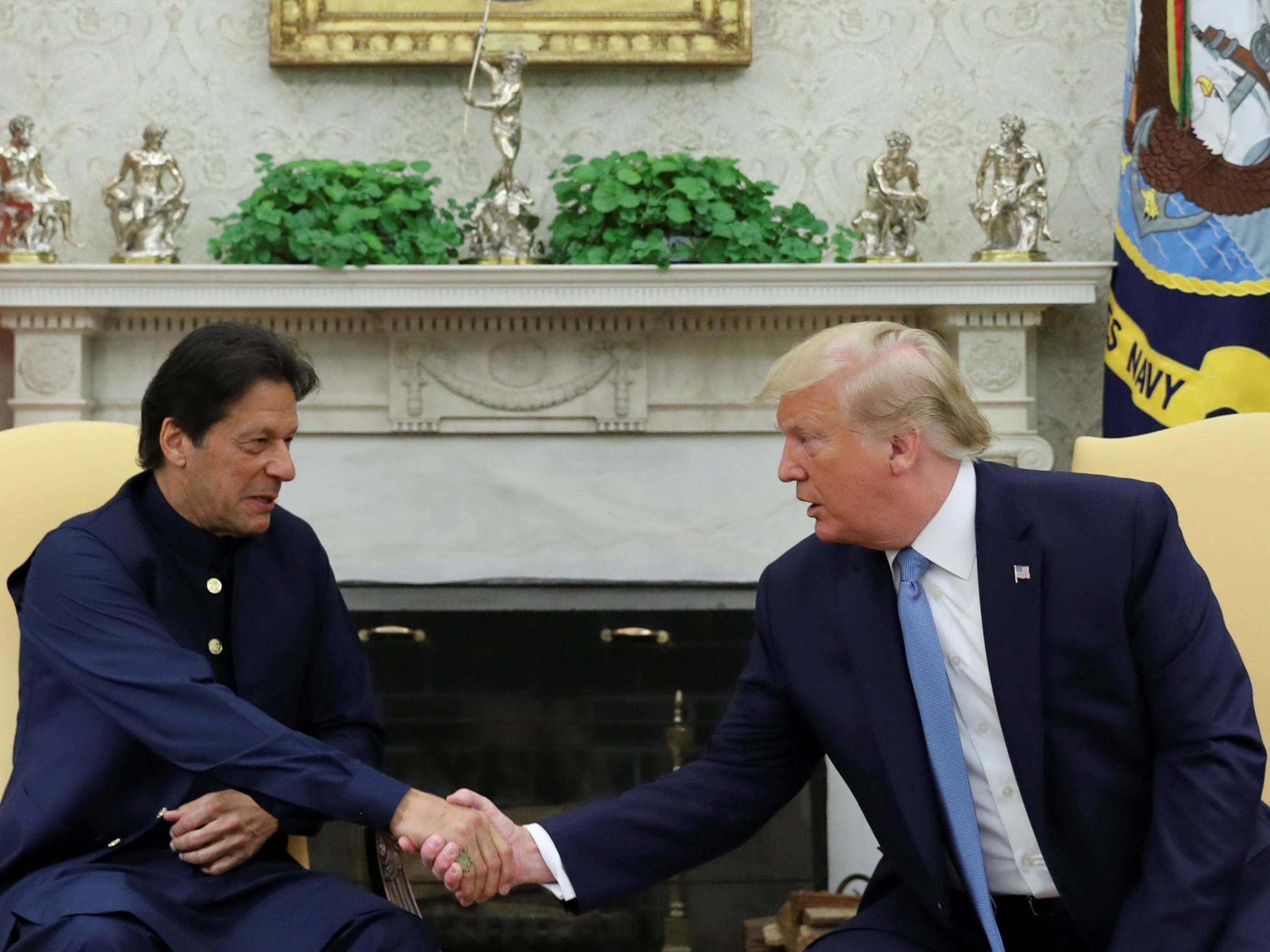
In the present context, Pakistan’s help to end the Afghan war can mean a big foreign policy achievement for Trump that would have mileage for his campaign for the presidential election next year in the US. Therefore, the probability is that Trump was being boastful by ‘declassifying’ fully or partly what must have been a highly sensitive exchange between him and Modi in Osaka without any aides present.
Suffice to say, Trump’s mediatory offer on Kashmir and the salience of Imran Khan’s visit to the US hold serious implications for Indian policies.
First and foremost, the Modi government recoiled from the backlash of Indian public opinion regarding Trump’s mediatory offer. In reality, though, India has selectively accepted US mediation in the past, the best known example being the Kargil War in 1990. Therefore, even if Modi had sought Trump’s mediation, it would have been nothing extraordinary.
In fact, tactically, it would have been a clever ploy to pin down Trump to the neutral ground as regards India-Pakistan tensions even as Imran Khan was to shortly undertake a momentous visit to the US.
Indeed, Imran Khan’s visit will cause disquiet in the Indian mind insofar as Trump is promising to Pakistan a seamless alliance. This is happening at an awkward moment for India when the guns have fallen silent on the India-Pakistan border and the cross-border infiltration of militants to J&K has dried up lately.
The Modi government is just about to roll out a new strategy toward the J&K situation. The Indian Defence Minister Rajnath Singh publicly announced only last week that a final solution to the J&K situation is ‘imminent’.
A reasonable guess is that the Modi government plans to integrate J&K by divesting or eroding some of its so-called ‘special status’, taking advantage of the perceived Pakistani capitulation on cross-border terrorism. That plan may now have to be put on the back burner.
One of the basic assumptions behind that plan is that there isn’t going to be any international repercussions if Delhi robustly pushed the project forward, with coercion if need be, to integrate J&K. But Trump may have now shaken up the Indian confidence. Trump drew attention to the security situation in the Indian state of Jammu & Kashmir, the longstanding character of the Kashmir problem and the singular inability of India and Pakistan to resolve the dispute bilaterally.
The way things are developing in the equations between Washington and Islamabad at the highest level of leaderships, Pakistan has succeeded in getting the US to accept a linkage between any Afghan settlement and a resolution of the Kashmir dispute. Trump’s remarks in their totality implicitly seems to acknowledge such a linkage.
At any rate, for the big hand that Pakistan is holding out to Trump to help end the Afghan war and claim a foreign-policy trophy in 2020, it will expect far greater US sensitivity toward Pakistan’s legitimate interests in regional security and stability, where its longstanding demand is for ‘strategic balance’ in South Asia. In the Pakistani estimation, ‘strategic balance’ requires a rest of the US’ South Asia policy compass, which tilts in favour of India.
Trump’s remarks suggest that he accepts in principle that goodwill and cooperation makes a two-way street. Therefore, Trump’s explosive disclosure will also have resonance with the Kashmiri people who are already alienated from the Indian state. Trump may have unwittingly given hope to the Kashmiris.
J&K’s planned ‘integration’ now becomes an uphill task for the Modi government. Nonetheless, Delhi is not going to be deterred from integrating J&K on terms that Bharathiya Janata Party, India’s ruling party, has unwaveringly set as its goal. From Delhi’s mild reaction to Trump’s remarks, it seems Modi government hopes to continue to tackle POTUS by making concessions elsewhere — such as, more lucrative arms deals.
The Indian analysts often speak of foreign policy under Modi as one of ‘multi-alignment’. But in practice, Indian policies operate on the ground as if the world community is an animal farm where the US remains more equal than others. Simply put, the Indian elites desire it that way, the bureaucrats are au fait with it and the Diaspora in North America, which roots for Hindu nationalism, demands it.
This is where the fundamental contradiction lies. When Trump says he is raring to mediate on Kashmir and help normalise India-Pakistan relations, he has unceremoniously trespassed on India’s core interests. Hopefully, this will trigger an Indian rethink in a longer term perspective rather than as a storm in the tea cup, given the high probability that Trump will remain in power for a second term as well.
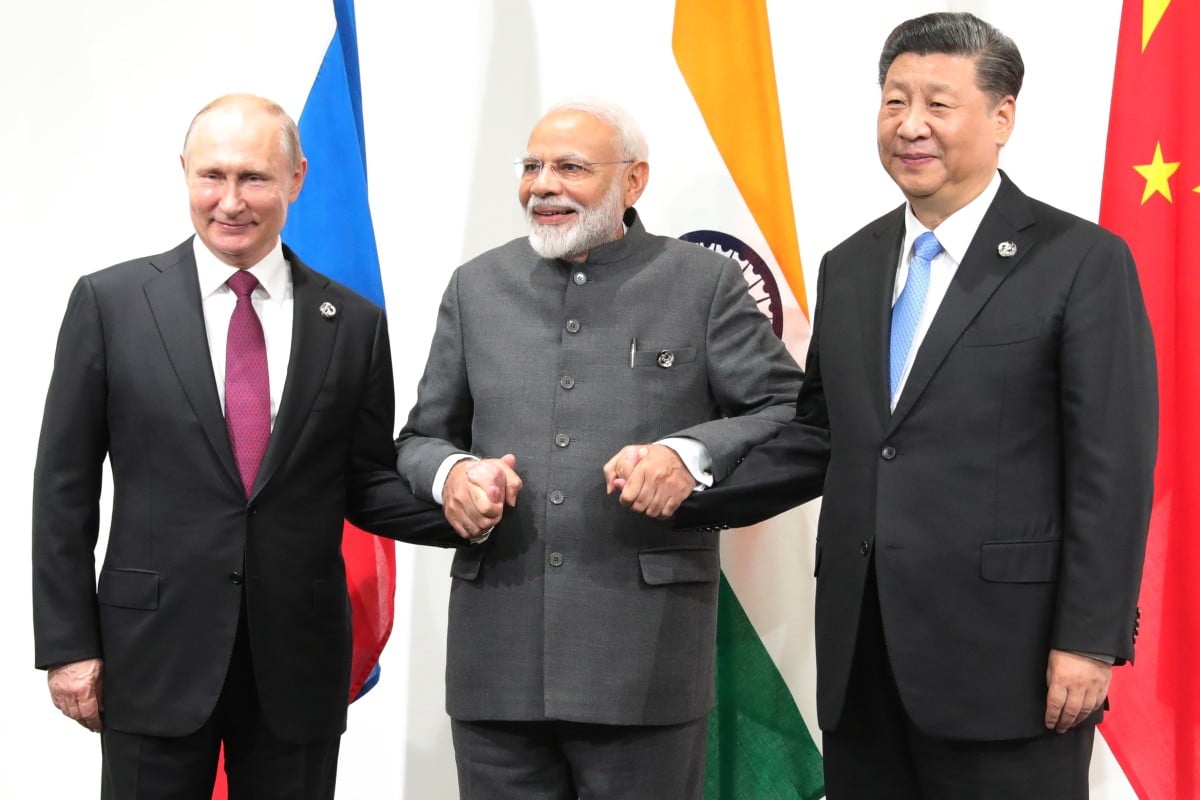
Such poignant moments underscore that India’s strategic ambivalence in the contemporary world order, characterised by growing multipolarity, is becoming increasingly untenable. Modi’s forthcoming visit to Russia in September and the visit by Chinese President Xi Jinping to India in October will provide significant pointers to the Indian policies in the changing regional and international milieu.
Related Videos
from Respect https://ift.tt/32X1Hnr
Breaking News: Modi’s Ship Hits the Kashmir Iceberg - News Paper

0 komentar:
Post a Comment