Global Research, July 16, 2019

On the night of June 19-20, Iran shot down a US Global Hawk reconnaissance UAV over the Strait of Hormuz.
President Trump responded by calling for retaliatory air strikes against Iran.
In response to the President and Commander in Chief’s instructions, US Central Command (CENTCOM), confirmed the deployment of US Air Force F-22 stealth fighters at CENTCOM’s Middle East forward headquarters at the al-Udeid airbase in Qatar, with a mandate to “defend American forces and interests” in the region against Iran. (See Michael Welch, Persian Peril, Global Research, June 30, 2019).
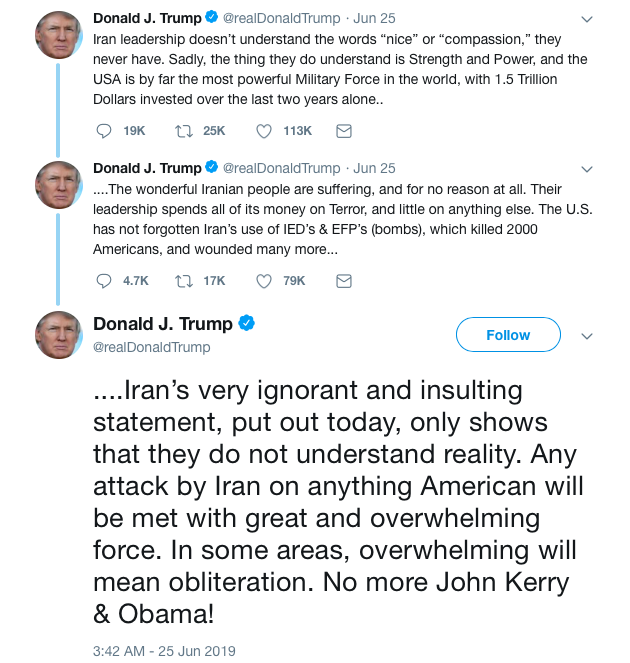
And then Commander in Chief Donald Trump decided spontaneously to retract his decision to bomb Iran, while intimating in his tweet that:
“any attack by Iran on anything American will be met with great and overwhelming force. In some areas overwhelming will mean obliteration”
According to the Washington Post
Early in the day, the president said he called off the attack at the last minute because it would have killed 150 people in retaliation for the downing of the drone. “We were cocked & loaded to retaliate last night on 3 different sights when I asked, how many will die,” he tweeted.But administration officials said Trump was told earlier Thursday how many casualties could occur if a strike on Iran were carried out and that he had given the green light that morning to prepare the operation.The confusion reinforced concerns about the Trump administration’s credibility at a time of military crisis.
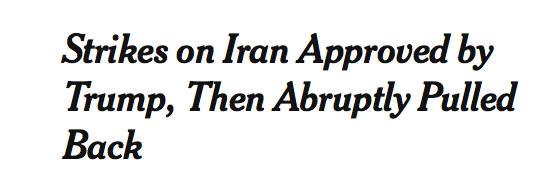
Headlines of NYT
Trump’s concern for casualties was a smokescreen. What the Pentagon was concerned with was not only Iran’s ability to defend itself in the case of a US attack, but also its potential to strike back,targeting US military facilities in the Middle East.
In a bitter irony, the “high tech” Global Hawk AUV (“with state-of-the-art electronic protection”) was shot down by the “low tech” Raad anti-aircraft missile system, “which bears a striking resemblance to the outdated Soviet Kub (Cube) system”.
“That does not look good”. Visibly there was also an issue of self-esteem, face saving on the part of Donald Trump and failure of US advanced weapons systems.
While Iran possesses Russia’s S-300 air defense system (and will soon be acquiring Russia’s state of the art S-400), Tehran chose not to deploy its most advanced air defense system in the Strait of Hormuz:
The Raad has a modified homing head, and Iran may have received the homing head technology from Russia.This may explain why the US drone outfitted with state-of-the-art electronic protection failed to escape the attack of the Iranian missile.” (Dmitriy Sudakov, Pravda Report, July 15, 2019)
Sudakov’s analysis published by Pravda provides important details regarding the June 19-20 incident, focussing on Iran’s air defense capabilities as well as the vulnerability of the US in the case of an air attack.
It just so happens that the 15-ton giant drone worth $220 million with a wingspan of 40 meters failed to escape from an Iranian missile. Iran has ceased to reckon with the United States. Amir-Ali Hajizade, the head of the Revolutionary Guard’s aerospace division, said that there was a P-8 Poseidon military aircraft flying next to the US UAV. The P-8 Poseidon was carrying 35 people on board. The military aircraft, the official said, invaded Iranian air space too, but Iran chose not to shoot the airplane down. Instead, Iran shot down the drone.
While the drone was brought down with an upgraded version of an outdated Soviet era technology, Iran is in possession (since 2015) of the S-300 Air defense system, which is considered to be more advanced than the US Patriot system:
In 2016, Iran bought four divisions of S-300 Favorit anti-aircraft missile systems from Russia. Each division includes 12 launchers. The Favorit (“Favorite”) range reaches 200 km; the system can easily eliminate all aircraft, including medium-range missiles.
It is worthy of note that Russia readies to launch a new generation of air defense systems known as S-500 Prometei (Prometheus), while the United States has not been able to design anything that could be superior to Russia’s S-300 missile complex. The THAAD system has a different purpose – to strike trans-atmospheric ballistic missiles. The Patriot system clearly lags behind the S-300. (Dmitriy Sudakov, Pravda Report, July 15, 2019)
According to Sudakov, “Iran can launch a total of about 400 S-300 missiles to distances up to 200 kilometres and 1,500 missiles – up to 40 kilometers.” What this suggests is that Iran has the ability to trigger extensive damage to US military installations in The Persian Gulf (including US military bases located in Kuwait, Bahrain and Saudi Arabia).
*
Note to readers: please click the share buttons above or below. Forward this article to your email lists. Crosspost on your blog site, internet forums. etc.
Featured image is from Mil.ru
The original source of this article is Global Research
Copyright © Prof Michel Chossudovsky, Global Research, 2019
from Respect https://ift.tt/2Z1G82K
Breaking News: How Iran’s Soviet Era Air Defense System Shot Down America’s Global Hawk UAV over Strait of Hormuz - News Paper

0 komentar:
Post a Comment