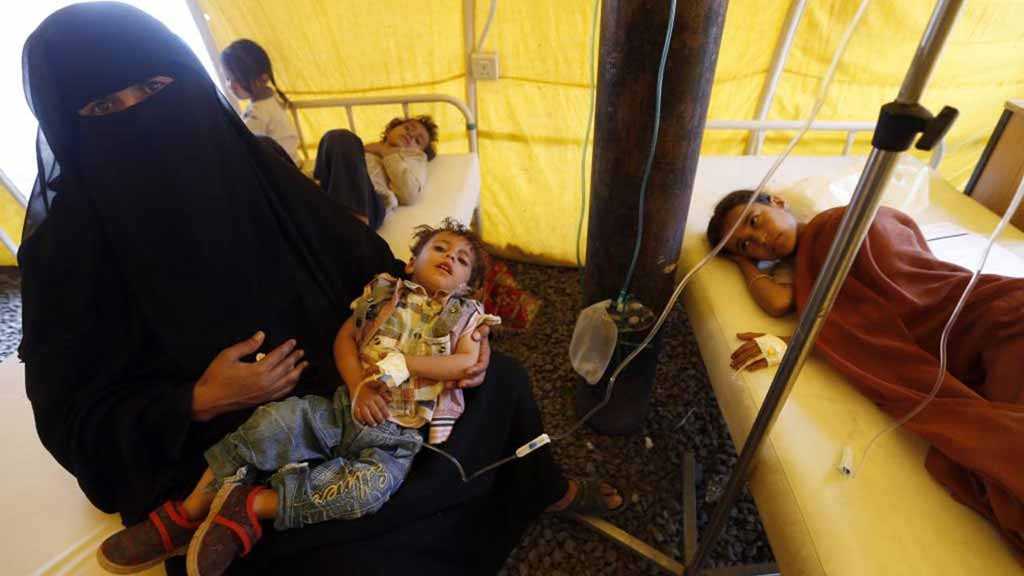
Oxfam warned Thursday that war-torn Yemen risks a “massive resurgence” of cholera, with around 195,000 suspected cases of the disease recorded so far this year.
“Fears that the world’s worst cholera outbreak could be set for a massive resurgence are growing,” the relief organization said.
It said aid agencies were struggling to reach suspected cases.
In a statement, Oxfam pointed to “fighting and restraints on access, including checkpoints and permit requirements imposed by the warring parties,” and warned the coming rainy season was likely to accelerate the spread of the disease.
The water-borne bacterial infection has claimed more than 3,000 lives in Yemen since the outbreak began in 2016, according to Oxfam.
At a medical center for the displaced in the western town of Khokha, Qassem Suleiman had brought his son Alaa for tests after a serious case of diarrhea.
Doctor Wadah al-Tiri told AFP that several patients had been transferred to Aden while others had been treated at the Khokha center.
He said a tent was to be set up for suspected cases.
The doctor said Yemen badly needed international aid to combat the epidemic.
The UN’s humanitarian coordination office OCHA said last month that children under the age of five make up nearly a third of this year’s cases.
The spike, which comes two years after Yemen suffered its worst cholera outbreak, was concentrated in six governorates including in the Red Sea port of Hudaydah and Sanaa province, both combat zones, it said.
Yemen’s conflict has created the perfect environment for cholera to thrive, as civilians across the country lack access to clean water and health care.
UN: Yemen’s Children Suffer ‘Devastating Toll’ in 5-Year Conflict
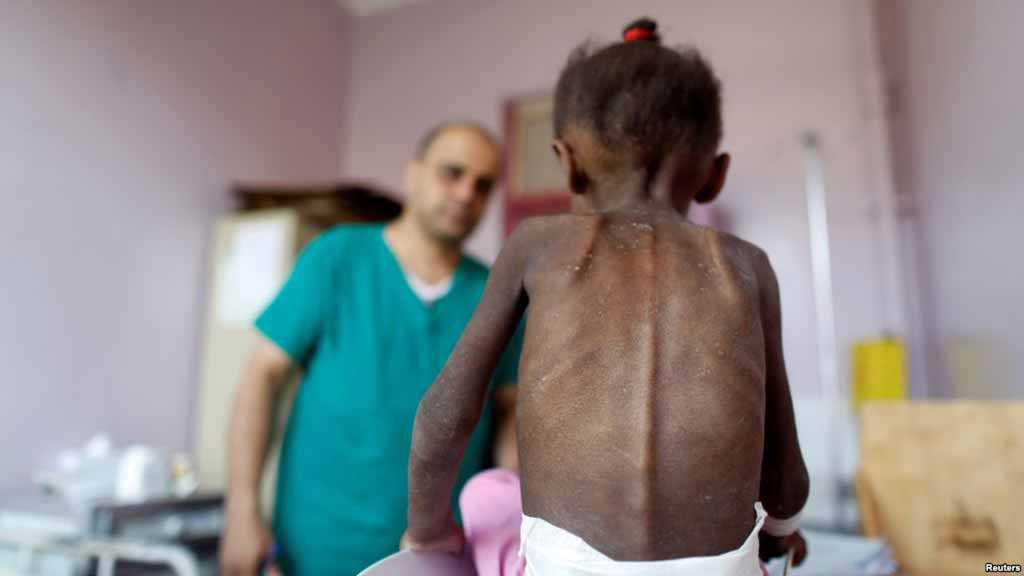
The United Nations said Monday that the five-year-old conflict in Yemen has taken a “devastating toll” on the country’s children, with thousands killed, maimed and recruited to fight since the war began.
“The impact of this conflict on children is horrific,” Virginia Gamba, UN special representative for children and armed conflict, told a meeting of the Security Council. “All parties to the conflict have acted and reacted militarily to events resulting in the use and abuse of children in multiple ways.”
Since monitoring began in Yemen in April 2013 (before the conflict fully erupted) until the end of the 2018, Gamba said more than 7,500 children had been killed or maimed and more than 3,000 have been verified as recruited or used, and there have been more than 800 documented cases of denial of humanitarian access to children.
Gamba said children reportedly have been forcibly recruited from schools, orphanages and communities to fight on the front lines, man checkpoints, deliver supplies or gather intelligence.
Last year, over half of the children recruited were under the age of 15. During that period, the UN says more than 200 were killed or maimed while being used by the warring parties.
In addition to harm to child soldiers, Gamba said of the more than 7,500 children martyred or maimed between 2013 and 2018, nearly half of the casualties were caused by Saudi-coalition airstrikes.
Another 40 percent of such casualties came in ground fighting, including shelling and mortars.
The UN has been working to end the conflict. On Monday, special envoy Martin Griffiths offered a glimmer of hope that the parties might be ready to take a first step away from the battlefield.
He told council members that both sides of the conflict have accepted a detailed redeployment plan to begin moving their fighters away from the crucial Red Sea port city of Hudaydah.
“We will now move with all speed toward resolving the final outstanding issues related to the operational plans for phase two, redeployments and also the issue of the status of local security forces,” Griffiths told the council in a video briefing from Amman, Jordan.
The parties committed to the plan at talks in Stockholm in December, but efforts to implement the agreement have failed. Griffiths expressed some confidence that they would go forward now.
“When — and I hope it is when and not if — these redeploys happen, they will be the first ones in this long conflict,” he said.
Griffiths acknowledged that the “the war in Yemen … shows no sign of abating,” and said there needs to be real progress on the military redeployments before the focus can shift back to the political track.
US Acting UN Ambassador Jonathan Cohen welcomed Ansarullah acceptance to phase one of the withdrawal plan and said Washington would be “watching closely to see if they make good on that agreement.”
Meanwhile, UN humanitarian operations in Yemen are at risk of running out of money in the coming weeks.
UN aid chief Mark Lowcock said that nearly four months into 2019, the response plan has received only $267 million in actual funding.
“UN agencies are rapidly running out of money for essential relief activities,” he warned.
The country, which is facing a cholera epidemic, could see 60% of its diarrhea treatment centers close in the coming weeks if money is not received. UN food programs, which provide emergency food assistance to more than 9 million people every month, would also be impacted.
“Closing or scaling back such programs — at a time when we are struggling to prevent widespread famine and roll back cholera and other killer diseases — would be catastrophic,” Lowcock said.
He also warned that a potential environmental disaster is brewing off of Yemen’s Red Sea coast.
Lowcock said that an oil tanker used as a floating storage and offloading facility, and which is 8 kilometers off the coast at the Ras Isa terminal, is old and has not received any maintenance since 2015. It has about 1.1 million barrels of oil on board.
“Without maintenance, we fear that it will rupture or even explode, unleashing an environmental disaster in one of the world’s busiest shipping lanes,” Lowcock said.
A Saudi Arabian-led coalition began bombing Yemen in March 2015. Since then, the UN estimates more than 10,000 people had been martyred, mostly due to US-backed Saudi-led coalition airstrikes.
Related Videos
Related News
from Respect http://bit.ly/2PhJfzu
Breaking News: Oxfam: Yemen Risks «Massive Resurgence» of Cholera - News Paper

0 komentar:
Post a Comment