A poorly chosen phrase hides a valuable idea: Work isn’t everything.
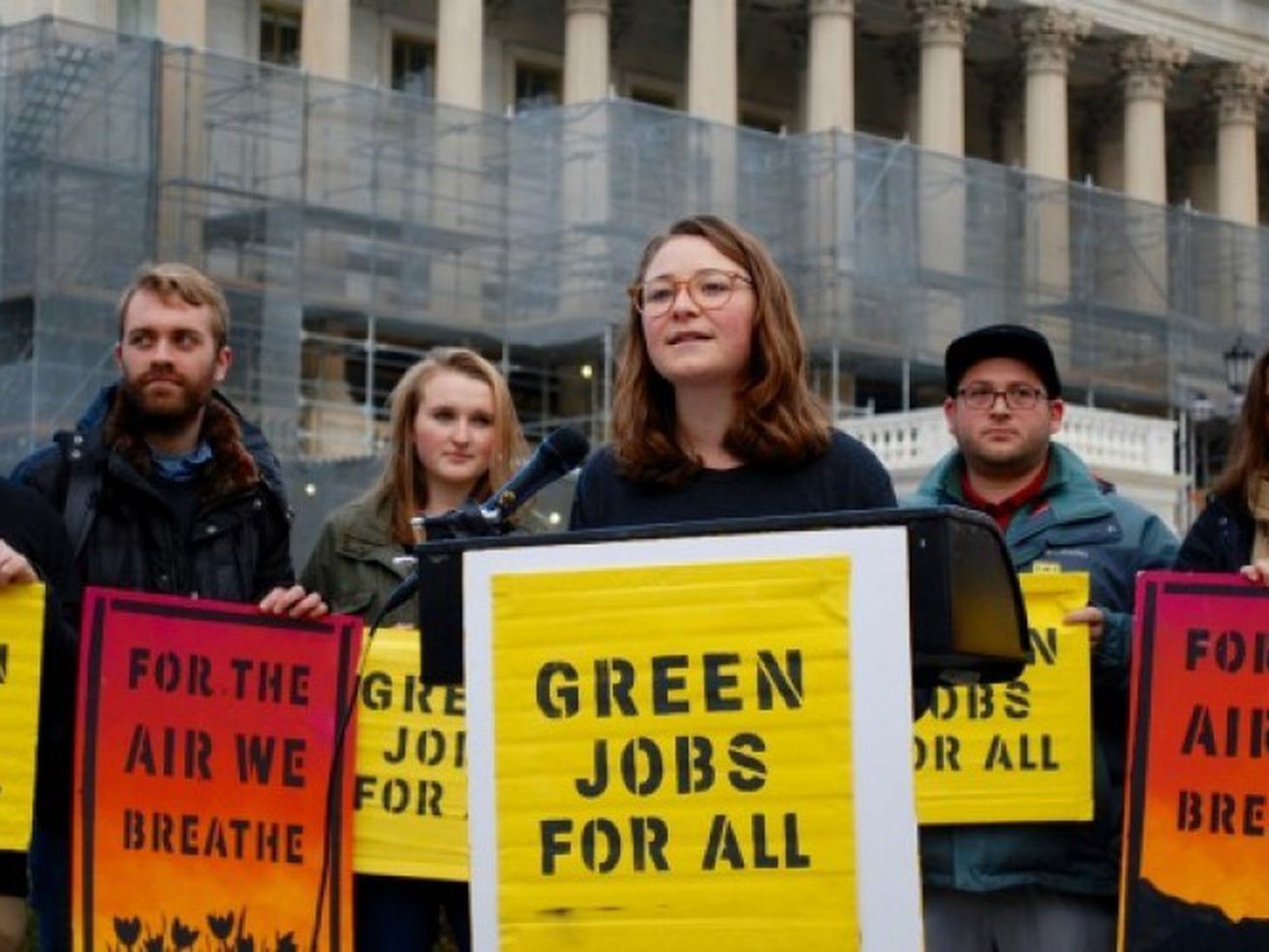
One aspect of the Green New Deal, according to a summary that appeared briefly on a congressional website, would be to provide “economic security for all who are unable or unwilling to work.” Those last three words offered such fodder to Fox News that the summary was withdrawn and supporters such as Rep. Alexandria Ocasio-Cortez declared the only relevant document the legislative text of the Green New Deal resolution itself.
But before we send the last copies of that apparently sloppy document to the shredder, let’s consider what might have been meant by “unwilling to work.” Is there a case for supporting those who at a particular moment are neither “working” nor “unable to work”? Is there an insight there worth salvaging?
The phrase does conjure up the image of Seinfeld’s George Costanza dodging calls from the unemployment office checking on whether he’s been looking for work. Someone involved in writing that Green New Deal summary should have slowed down and figured out what they really wanted to say.
Washington Post reporter Dave Weigel on February 12 tweeted his interpretation of the document: “What AOC’s team meant was that people at the end of their working life would get a big pension instead of, like, coding classes.”
Perhaps it refers merely to permitting earlier retirement, but there’s a larger point: When we say that only people “unable” to work should share in economic security, it implies something like disability insurance, a program that requires an individual to demonstrate, often through a complex process that requires a lawyer, that they absolutely cannot work because of an identifiable disability. Only about 36 percent of applicants make it through that process successfully. Disability, retirement, education, and a short period after a child is born are the only exceptions to the general rule that we expect adults to be working.
Over the last several decades, through periods of both Republican and Democratic dominance, the US has built a social contract organized around the obligation to work in the market economy. From the emergence of the Earned Income Tax Credit in the Reagan era through work requirements, first in welfare reform and now proposed or implemented by waiver in the food stamp and Medicaid programs, policy has steadily enshrined the distinction between those gainfully employed — and thus deserving — and those not.
Provisions such as the refundable child tax credit enacted in 2001 were made unnecessarily complex solely to ensure that anyone not working be denied that modest benefit.
Political rhetoric has reinforced the point. Conservative language has been harsh and punitive, building on images such as the “welfare queen” of the 1980s. More recently, there’s the idea that people who are poor have chosen not to follow the “success sequence” of school, marriage, and full-time work.
Progressive rhetoric has always been more optimistic and supportive. Bill Clinton saluted those who “work hard and play by the rules,” while Sen. Sherrod Brown invoked “the dignity of work,” a wonderful phrase picked up by several other Democratic candidates. While Brown always includes caregiving and work in the home, the implication remains that dignity is an attribute of labor, not simply of being human.
Some conservative and liberal policies are punitive while some are meant to provide support. Conservative rhetoric as well as liberal rhetoric have ratcheted the social contract in the direction of supporting only people who are working in the market economy or can demonstrate that they can’t.
Social insurance programs recognize defined exceptions to the rule of work: Education (usually in the early stages of adult life), retirement (nearer the end), and disability. Paid family leave would add a fourth. Unemployment insurance provides temporary support for people who have worked steadily for years and who can show they’re looking for work. Tax-advantaged savings programs, which have been the main tool of social policy in recent decades even though they overwhelmingly benefit the upper-middle class, similarly target benefits for specific life events: college education, retirement.
But life can be more complicated than these categories allow. There are situations like the one Weigel identified when, a few years short of Social Security eligibility age, we find our experience or credentials no longer in demand. There are moments when we simply must quit a job, without a plan, for our own mental health, perhaps because of an abusive boss. Maybe we need to go spend six months with a relative who is recovering from postpartum depression or a drug overdose. Our child is having a hard time in second grade and we really need to be home for her at 3:00. We might even want to take a year to write a novel. There’s no reason to discourage that, even if after a year we discover that fiction isn’t our genre.
One policy approach would be to build new programs that target these needs, such as very flexible family leave or some provision for earlier retirement, starting by lowering the eligibility age for Medicare. The political process might recognize a wider range of legitimate excuses for not working, even if novel-writing won’t be one of them. The point is, these are just examples of the many unpredictable circumstances in which we might find ourselves not quite “unable to work,” but far better off — and other people would be better off — if we could step out of the market economy for some period of time.
One attribute gives people the freedom to make their own choices in situations like those above: Wealth. Not vast wealth, and not wealth that’s tied up in a house or a retirement account. Just $10,000 or $40,000 in a liquid account can make many things possible. But according to the Federal Reserve’s most recent report on household finances, four in 10 adults don’t have $400 for an emergency, and a majority have less than $1,000.
This kind of moderate savings also marks the sharpest racial divide. As researchers including William Darity Jr. and Darrick Hamilton have shown, the average white household near the poverty line in income has a net worth of about $18,000 (including housing value), while a similarly situated black family has zero or negative net worth.
Of the many ambitious policy ideas emerging at the moment, Universal Basic Income is the one that most explicitly discards the idea that work is the essential qualifier for public support. While many UBI supporters think it’s an appropriate response to a future in which there may be fewer jobs (because of the robots and all that), the idea has value regardless of one’s prediction about the future of work. Income from a UBI can form the basis of savings, but that won’t happen without accounts or incentives to set aside some income.
Other approaches, such as Sen. Cory Booker’s American Opportunity Accounts, would help people build savings, but much like social insurance programs, uses would be limited to specific purposes: education, retirement, homeownership. In a new book, A Few Thousand Dollars, Bob Friedman of the organization Prosperity Now, a longtime advocate for helping all families build savings, argues for a more flexible strategy to help households save for emergencies as well as other purposes.
Programs to encourage savings and assets are only one aspect of a social contract that recognizes the dignity of work but also the complexity of life. Work in all its many forms (both in and out of the home) gives life structure and meaning, but social policy should also acknowledge that work fits into life, at different points, in ways too unpredictable to capture in narrowly targeted programs. And we should aspire to design programs that help people work and earn, but also structure their lives in ways that can fulfill their aspirations, personal as well as economic.
from Vox - All https://ift.tt/2DYj77z
Breaking News: The case for helping the “unwilling to work” - News Paper

0 komentar:
Post a Comment