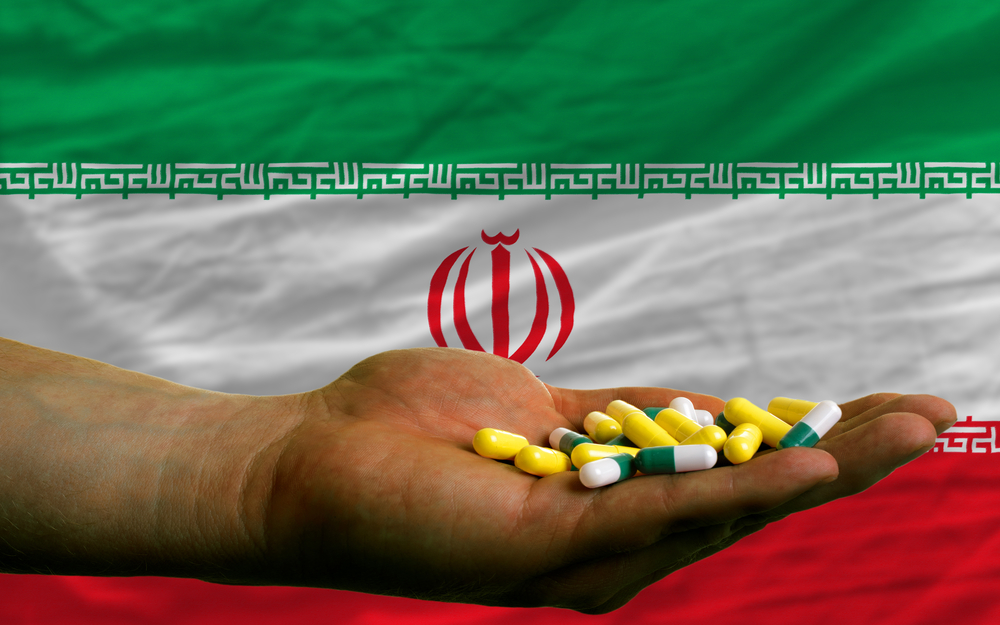
 Shutterstock
by Aveek Sen, Mojtaba Mousavi, and Udayan Tandan
Zeinab, the mother of a four-year-old girl suffering from blood cancer, says that “Mina has been under medication for nearly five months. The doctor had prescribed her pills recently and Mina has to take them every night for three years straight.” Zeinab adds, “We are spending really difficult days both physically and emotionally. It’s okay if you have no food at home, but in hospitals, there should be medicine for patients, for children. Whatever sanctions you’re imposing, don’t restrict medicine.”
Restrictions on importing pharmaceutical active ingredients reduced Iran’s medicine production during the last round of U.S. sanctions in 2012. “I am a PSC patient and I need Mesalazine and Ursobil on a daily basis,” said Amir, 29 who was diagnosed in 2008 with primary sclerosing cholangitis (PSC), a liver disease. “In 2012, I couldn’t find enough Mesalazine and my colitis activated again. That was an awful experience. The doctors told me that without regular intake of the medicines, I face serious damage to my liver. It may overtime metamorphose into colorectal cancer.”
U.S. officials have said repeatedly that the sanctions are designed to target the Iranian “regime,” and it has even issued a waiver for humanitarian goods. But in action, by imposing sanctions on Iranian bank transactions, the United States is effectively blocking the only way to buy medicine for Iranian patients.
“When banks are terrified to handle Iran-related transactions, it means we cannot even buy medicine, and if we do, we cannot transfer them into Iran since airlines won’t accept cargoes destined for Iran,” says a senior manager in an Iranian firm importing pharmaceuticals, speaking on the condition of anonymity.
Fear is the main weapon that the United States is using to enforce its sanction policy against Iran. “The fact is that the banks are so terrified by the sanctions that they don’t want to do anything with Iran,” said French ambassador to the UN Gerard Araud to The New York Times. “So it means that there is a strong risk that in a few months really there will be shortage of medicine in Iran.”
On October 3, 2018, judges at the International Court of Justice ruled that the United States had to remove “any impediments” to the export of humanitarian goods, including food, medicine and spare parts, and equipment and services necessary for the safety of civil aviation. The United States argued the ruling was a “defeat” for Iran, saying it already allowed humanitarian-related transactions.
“Excluding medicines from sanctions is just a false claim,” says Iranian Health Minister Hassan Ghazizadeh Hashemi. “We have many medical cargoes need to be transferred quickly but there is no airplane or ship to transfer them into Iran due to US sanctions.”
“If imports of drugs into the country are stopped right now, we are able to meet 50 percent of the nation’s need for medicines,” says Akbar Barandegi, the director general for pharmaceutical affairs at the Iranian Food and Drugs Organization.
Iran faced a shortage of life-saving medicines in 2012-13 due to economic sanctions imposed by the EU and the United States. Medicines were exempt from the sanctions. However, Europeans were reluctant to supply pharmaceuticals, primarily due to payment concerns since Western banks were wary of handling financial transactions with Iran.
In these circumstances Iran turned to India for a supply of essential life-saving drugs. The Indian pharmaceutical industry is known worldwide for its quality generic drugs. Indian pharma majors like Cipla, Ranbaxy, and Glenmark supplied Iran with bulk drugs, active pharmaceutical ingredients, and generic formulations of drugs used in the treatment of lung and breast cancers, brain tumors, and heart ailments, among others. In the cases of Cipla and Ranbaxy, they provided medicines to Iran despite having a major presence in the U.S. market.
With U.S. sanctions kicking in once again, Iran’s position has become precarious for it may face trouble importing essential items like food and medicine. Ajay Sahai, the director general of the Federation of Import-Export Organisations, remains cautiously hopeful since the United States has of yet not provided clarity on this issue. Also, he points out, if European companies bend to U.S. pressure, Indian pharmaceutical companies could again step in, particularly small- and medium-sized enterprises with no exposure to the U.S. market. India has also already obtained a sanctions exemption on oil imports, and the payment mechanism between the two nations has been resolved. Sahai notes that Iranians will be eager to import from India in exchange for what India owes in oil payments.
Century Pharma is one Indian enterprise well-positioned to help Iran. It’s been in the business of manufacturing active pharmaceutical ingredients for the past three decades and has been regularly exporting to Iran, according to the company’s managing director, Janak Sheth. In fact, Century Pharma has already received two big orders from Iran in the last week.
“Every time Iran faces tight sanctions from Western countries, its trade with Asian countries, especially southeast Asian states, increases until whenever Iran decides to expand its relationship with the West,” says Javad Aminian, an expert in Iranian relations with South Asia. “So, we expect Iran’s trade with Asia to rise again during the new round of sanctions.”
Aveek Sen is an independent journalist working on cybersecurity and the geopolitics of India’s neighborhood, focusing on Pakistan, Afghanistan, Iran, and Bangladesh. @aveeksen. Udayan Tandan was a former legal consultant at the Enforcement Directorate and currently practices law in New Delhi. @udayantandan. Mojtaba Mousavi is the founder and editor of the Tehran-based analytical website, IransView.com. His writings on Iran’s foreign policy appeared in different Iranian and international media including Al-Monitor and Al-ahram weekly. @mousavimojo
from Respect https://ift.tt/2Euf31y
Breaking News: Will India Help Iran Avert U.S. Sanctions-Related Medical Crisis? - News Paper

0 komentar:
Post a Comment