By Eve Mykytyn
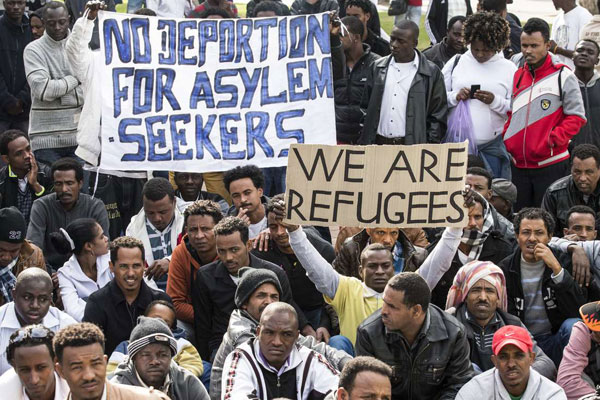
Take $3,500 and a one-way ticket to an ‘unnamed’ African country (Rwanda or Uganda) by April 1, or face indefinite imprisonment. This is what Israel told the 40,000 African migrants who have been stuck in limbo in Israel for years. According to the Israeli government, roughly 20,000 Africans have already been expelled.
On February 21, following the imprisonment of seven Eritreans who refused to leave Israel, 750 African asylum seekers detained at the Holot detention center began a hunger strike reportedly refusing both food and water.
It seems that Israel has come face to face with one consequence of trying to be a ‘nation like all others’: having to cope with the difficulties of refugees who want the protection of your state without necessarily subscribing to your values.
Israel calls itself the Jewish state (as opposed to a state of its citizens), and actively seeks Jewish immigrants. This has given religious identity a huge role in Israel, although Israel is largely secular. Israel has not yet become a ‘nation like all others’ in its treatment of non Jews. Its 20% Palestinian minority are second-class citizens.*
The African asylum seekers and its Palestinian citizens are not the only non Jewish residents of Israel has who have the potential of conflicting with Israel’s policy of being the Jewish state. Like many wealthy countries, Israel has chosen to import labor for the lower rungs of the pay scale. After the 1967 war, Palestinians crossed into Israel to work in construction and agriculture. Then following the first intifada in 1987, Israel banned most Palestinians from entering and decided instead to import labor from developing countries. By 2002, there were 226,000 migrant workers living in Israel. Such workers; Thais on farms, Chinese in construction, African street labor and Filipino caregivers are sometimes described as ‘transparents,’ communities invisible to most Israelis. These laborers were never intended to and largely have not been given permanent refuge in Israel.
To keep the migrant population from ‘taking root,’ as Israel’s Interior Ministry puts it, the ministry has devised a byzantine system of barriers. Work permits for foreign caregivers are valid for only five years and three months, and are meant to ensure their presence is transitory. They face additional restrictions on the locations in which they can work, their ability to marry, to ‘visit’ Israel with family members and in job mobility.
Nonetheless, Israel’s right wing parties see migrant workers as a direct threat to the country’s Jewish makeup. In 2008, the government moved to deport 1,200 children of undocumented foreign workers. After a public outcry the Israeli government granted amnesty to 800 children of migrant workers who met certain strict criteria. Other than this trivial number of new permanent residents, Israel has been successful in importing cheap labor without adding to its non Jewish citizenry.
Israel has taken in a number of Jews from relatively poor backgrounds, particularly Ethiopian Jews. While these immigrants may present more problems of integration then European or North American Jews, as Jews they fit Israel’s goal of remaining a primarily Jewish state.
In the 1990s over a million citizens of the former Soviet Union claimed Jewish ancestry and migrated to Israel . They and their progeny now constitute around 15% of Israel’s population of 7.7 million. Many of these immigrants are not Jewish. Anyone from the former Soviet Union who had a Jewish father or grandparent, or who was married to someone meeting those criteria, was granted Israeli citizenship under the country’s liberalized law of return.
According to Israel’s Central Bureau of Statistics around 30% of immigrants from the former Soviet Union in the 1990s were not Jews or not considered Jewish under Orthodox law (which treats Judaism as either inherited from the mother or obtained through conversion). In 2005 over 59% of former Soviet immigrants were not Jewish. Less than 5% of these nonJewish immigrants have converted.
The Russian immigrants initially encountered a scarcity of jobs and housing. They have now achieved near parity with other Israelis and have successfully gained political power. The former Soviets are an important part of Israel’s governing coalition and are relentlessly rightwing, reliably opposing concessions to the Palestinians, supporting settlement expansion and seeking to curb the rights of Israel’s Palestinian population.
Were the non Jewish ex Soviets accepted because they were right wing, because as Europeans they helped Israel to form a stronger bulwark against Palestinians or was it purely racism that allowed Israel to welcome these white skinned immigrants? Those decrying the rise of racism in Europe aroused by recent African immigration might consider adding Israel to their list of reprobates.
The African immigrants do not seem to serve a purpose for the Israelis, either as a political entity or in Israel’s goal of remaining a Jewish dominated state. Most of the Africans crossed into Israel through the Sinai desert between 2006 and 2012, fleeing harsh political conditions in Eritrea or genocide and war in Sudan. Their stay in Israel has not been easy. Many migrants spent years in the Saharonim prison in the Negev desert and were subsequently transferred to Holot. Some have been briefly released from these facilities to travel to Tel Aviv, only to be sent back again when the Ministry of Interior refused to renew their visas.
Human-rights organizations claim that most or all such migrants have a well-founded fear of persecution in their home countries and are entitled to asylum. Applicants for asylum face a years-long delay due to ‘backlog’ and in any case of the more than 13,000 people who had applied for asylum as of last summer, only 10 have been granted refugee status. Israel recognizes far fewer people in “refugee-like situations” as refugees when compared to almost all Western countries.
The Israeli government has argued that these migrants are not fleeing persecution but are ‘economic’ refugees looking for work in Israel. “In the last few days, a false campaign [has attempted] to harm the government’s efforts to remove infiltrators from Israel,” wrote Ayelet Shaked, the Israeli minister of justice. “The state of Israel is too small and has its own problems. It cannot be used as the employment office of the African continent.”
Despite protests from Israel’s left, opinion polls suggest that 70 percent of Israel’s Jewish population support Israel’s deportation policy. Possibly such broad support is the result of conditioning, native Israelis may simply see non-Jews within the state as a threat to their safety or to maintaining a Jewish majority. “It’s really hard for them to distinguish between the refugees and the Palestinians they were taught to be against,” said Rabbi Idit Lev, the social-justice director for Rabbis for Human Rights.
But Israel has not entirely behaved as if the migrants have no right to asylum. Although the government argues that the Eritrean and Sudanese migrants are not truly refugees, it has not sent them back to their country of origin as would be proper with economic immigrants. Doing so to refugees would violate international conventions around refugee rights.
The migrants do not want to be deported back to their own countries or to Rwanda. Although Israel pays the migrants to leave, those who have arrived in Rwanda report that their documents and money were confiscated on arrival and they ended up on the streets.
UNHCR said in a recent report that only nine asylum seekers deported to Rwanda have actually stayed there. What has not been adequately documented is where the refugees have gone from there. The African migrants claim that returning to their country of origin will mean certain death.
Economic immigration presents tough issues to many countries. If Israel is unable to deport the remaining 40,000 African immigrants, it may find itself a little more a country like all others.
* (GA) This doesn’t include the millions of Palestinians who live in Israeli controlled territories, lack any political status and are subject to constant lethal abuse…
from Respect http://ift.tt/2F2TqoT
Breaking News: ISRAEL’S ASYLUM SEEKERS - News Paper

0 komentar:
Post a Comment